TL;DR
- On-premises Kubernetes cluster designed for production-grade scalability and control
- Microservices-based MERN stack architecture (React frontend + Node.js backend)
- External traffic secured and routed via Cloudflare and Load Balancer
- NGINX Ingress Controller handles domain and path-based routing (
/and/api) - Fully containerized using Docker with images stored in a private registry
- Automated CI/CD pipeline powered by Jenkins
- Persistent shared storage implemented using NFS volumes
- Database layer uses MongoDB Replica Set for high availability
- Monitoring and observability with Prometheus + Grafana + Loki
- Designed for high availability, fault tolerance, and real-world production workloads
Project Overview
This architecture represents a self-managed Kubernetes cluster deployed on-premises, built to host a large-scale web application with real-world traffic. The system follows a microservices-based design, separating frontend, backend, and supporting services while ensuring:
- High availability
- Scalable infrastructure
- Secure internal communication
- Reliable data persistence
It is optimized for environments where cloud is not preferred, giving full control over infrastructure.
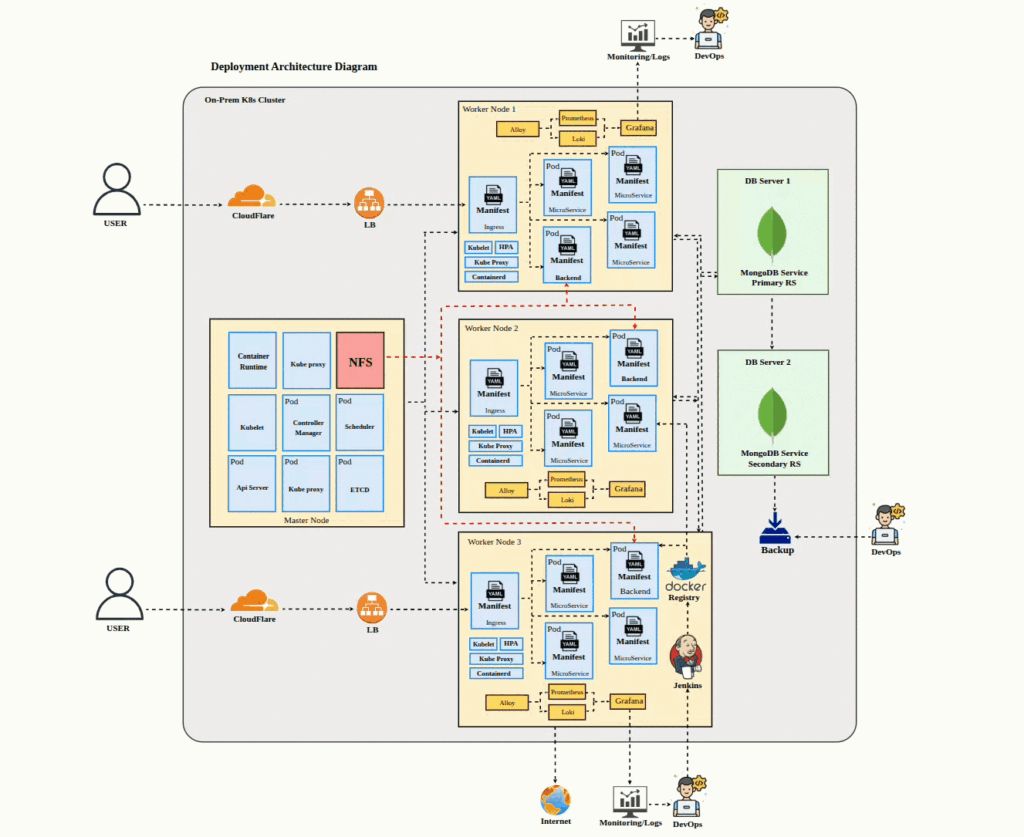
Goals of the Architecture
- Build a highly available on-prem Kubernetes cluster
- Enable scalable microservices deployment
- Ensure secure internal networking
- Implement persistent shared storage (NFS)
- Establish complete CI/CD pipeline
- Provide real-time monitoring and logging
High-Level Architecture
At a high level, the system works like this:
- Users access the system via Cloudflare
- Traffic is routed through a Load Balancer
- Requests enter Kubernetes via Ingress Controller
- Microservices run across multiple worker nodes
- Backend services interact with a replicated database cluster
- Monitoring and logs are collected centrally
Traffic Flow
User → Cloudflare → Load Balancer → Kubernetes Ingress → Services → Pods (Frontend/Backend) → MongoDB Replica Set → Response → User
Core Components
Kubernetes Cluster (On-Prem)
- Master Node
- API Server
- Scheduler
- Controller Manager
- ETCD
- Worker Nodes
- Application Pods (Frontend + Backend + Microservices)
- Kubelet, Kube Proxy
- Container Runtime
Application Layer
- Frontend (React + NGINX)
- Served as optimized static assets
- Backend (Node.js API)
- Handles authentication, business logic, file uploads
- Microservices
- Scalable and independently deployable
CI/CD & Container Management
- Jenkins – CI/CD pipeline
- Private Docker Registry – Secure image storage
- Docker – Containerization with multi-stage builds
Storage & Persistence
- NFS Server
- Shared storage across pods
- Persistent file handling (PDFs, uploads)
Observability
- Prometheus – Metrics collection
- Grafana – Visualization dashboards
- Loki + Alloy – Log aggregation
Database Layer
- MongoDB Replica Set
- Primary + Secondary nodes
- Ensures redundancy and failover
- Backup system for data protection
Networking & Traffic Flow
The architecture uses a secure VPC design with public and private subnets:
- Public Subnet:
- Load Balancer
- Bastion Host
- Private Subnet:
- EKS Cluster
- Database
Data Layer & Persistence Design
- MongoDB Replica Set
- High availability with primary-secondary replication
- NFS Storage
- Shared file storage across pods
- Ensures persistence beyond pod lifecycle
Key Advantage:
Even if pods restart, data remains intact and accessible.
Key Design Choice:
All application services are stateless, making scaling easy and reliable.
Security Design
- Cloudflare for DDoS protection and edge security
- Private internal cluster networking
- Kubernetes Secrets & ConfigMaps for sensitive data
- Controlled access to private Docker registry
- No direct public exposure of internal services
- Role-based access control (RBAC) in Kubernetes
CI/CD & Deployment Strategy
- Developer pushes code
- Jenkins pipeline triggers
- Docker images are built
- Images pushed to private registry
- Kubernetes pulls images securely
- Deployments updated using manifests
✔ Supports:
- Versioned releases
- Rollbacks
- Controlled production deployments
Key Learnings
- On-prem Kubernetes requires strong networking knowledge
- Persistent storage (NFS) is critical for real-world apps
- CI/CD pipelines must handle private registry authentication
- Monitoring and logging are essential for debugging
- Microservices improve scalability but increase complexity
- Proper ingress configuration is crucial for routing