TL;DR
A scalable, secure, and production-ready cloud architecture built on Amazon Web Services using Amazon EKS. It combines microservices (React, Django, Celery), CI/CD with GitHub Actions, and managed services like Amazon RDS and Amazon S3 to deliver a high-performance production system.
Project Overview
This project demonstrates a modern cloud-native architecture designed to run production workloads efficiently. The system is deployed on Kubernetes using EKS and follows a microservices approach, separating frontend, backend, background processing, and monitoring.
It ensures:
- High availability
- Fault tolerance
- Secure networking
- Automated deployments
Goals of the Architecture
- Build a highly scalable system using Kubernetes
- Ensure secure communication within private networks
- Automate deployments with CI/CD pipelines
- Achieve high performance under load
- Implement centralized logging and monitoring
- Follow DevOps and cloud-native best practices
High-Level Architecture
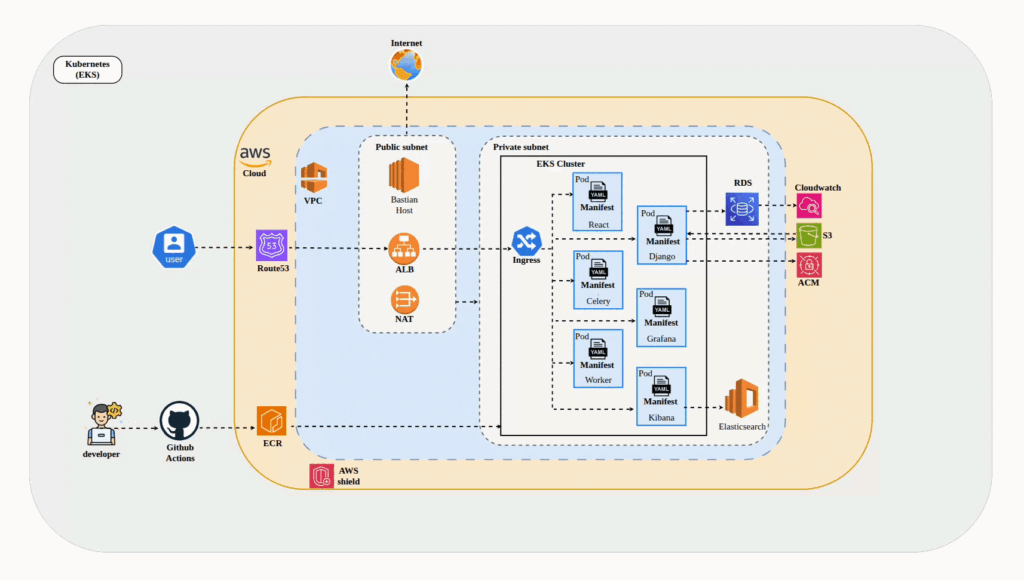
At a high level, the system works like this:
- Users access the application via DNS using Amazon Route 53
- Traffic is routed through an AWS Application Load Balancer
- Requests enter the Kubernetes cluster via Ingress
- Services inside Amazon EKS handle application logic
- Backend services interact with database and storage layers
- Logs and metrics are collected for monitoring and debugging
User → Amazon Route 53 → AWS Application Load Balancer → Kubernetes Ingress → Amazon EKS (React / Django Services) → Amazon RDS / Amazon S3 → Response back via ALB → User
Core Components
Compute & Orchestration
- EKS Cluster – Manages containerized applications
- Kubernetes Pods
- React (Frontend UI)
- Django (Backend API)
- Celery (Async processing)
- Workers (Background jobs)
- Grafana & Kibana (Monitoring dashboards)
Container & CI/CD
- Amazon Elastic Container Registry – Stores Docker images
- GitHub Actions – Automates build and deployment pipelines
Data & Storage
- Amazon RDS – Primary database
- Amazon S3 – Static files, backups, media
Observability
- Amazon CloudWatch – Metrics and logs
- Elasticsearch + Kibana – Log analysis
- Grafana – Real-time dashboards
Networking & Traffic Flow
The architecture uses a secure VPC design with public and private subnets:
- Public Subnet:
- Load Balancer
- Bastion Host
- Private Subnet:
- EKS Cluster
- Database
Data Layer & Persistence Design
- Amazon RDS
- Handles structured data
- Supports high availability and backups
- Amazon S3
- Stores files and static assets
- Highly durable and scalable
Key Design Choice:
All application services are stateless, making scaling easy and reliable.
Security Design
Security is implemented at multiple layers:
- VPC Isolation (Public vs Private subnets)
- IAM Roles for service-level permissions
- AWS Shield for DDoS protection
- AWS Certificate Manager for HTTPS
- NAT Gateway for secure outbound access
- No direct public access to database or backend
CI/CD & Deployment Strategy
The deployment pipeline is fully automated:
- Developer pushes code to GitHub
- GitHub Actions triggers pipeline
- Docker images are built and pushed to ECR
- Kubernetes manifests are applied
- Rolling updates ensure zero downtime deployments
Key Learnings
- Kubernetes works best with stateless microservices
- Proper network segmentation is critical for security
- Observability tools are essential in production
- CI/CD automation reduces deployment risks
- Managed services reduce operational overhead
- Security should be implemented from the start